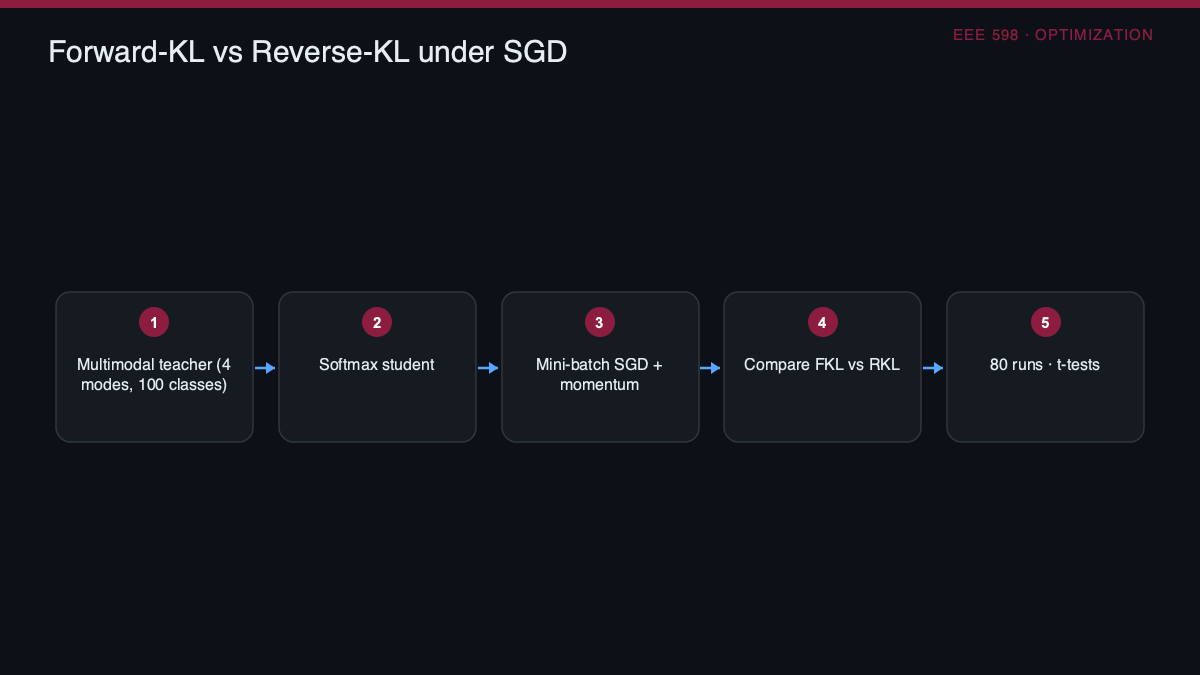
Empirical study of Forward-KL vs Reverse-KL divergence under stochastic gradient descent
A graduate stochastic optimization project (EEE 598, ASU) comparing two probability distribution matching objectives: Forward Kullback-Leibler (FKL) and Reverse Kullback-Leibler (RKL) divergence. A parameterized softmax student distribution is trained via mini-batch SGD with momentum to match a fixed multimodal teacher over 100 classes. The study runs 20 independent trials per configuration to evaluate convergence, stability, and distribution quality, with statistical significance testing of the results. **Highlight:** Mode coverage: FKL 95% vs RKL 68% (p < 0.001) across 20 independent runs
The distribution matching problem was framed as optimizing a softmax student distribution against a fixed multimodal categorical teacher using mini-batch stochastic gradient descent with momentum. Stochasticity was introduced by sampling mini-batches (size 32 and 128) from 10,000 teacher-drawn samples rather than the analytical distribution. Convergence was defined as the iteration where loss fell below 1.05x the run minimum, and performance was assessed via iterations-to-convergence, final loss, total variation distance, and mode coverage. Twenty independent runs per configuration with paired t-tests provided statistical rigor.
Forward-KL converged more steadily (1,450 +/- 80 iterations, final loss 0.032 +/- 0.004, TV distance 0.075) with comprehensive mode coverage, while Reverse-KL converged faster but with higher variance (1,200 +/- 220 iterations, final loss 0.041 +/- 0.010, TV distance 0.092) and selective mode coverage. Differences in mode coverage, final loss, and TV distance were statistically significant; full numbers, figures, and tables are in docs/Final_Report_EEE598.docx.